The Curious Case of Thomas Bayes
2026-01-06
A note of history
“Traditional” statistics (Dienes 2011)
Bayesian statistics
Plausibility
Bayesian statistics starts from the premise that we can assign degrees of plausibility to theories, and what we want our data to do is to tell us how to adjust these plausibilities.
– Dienes (2011)
\[ \text{Pr}(\text{hypothesis} \mid \text{data}) \]
Getting up
- Turn off alarm
- Get out of bed
Going to sleep
- Get in bed
- Count sheep
Code blocks
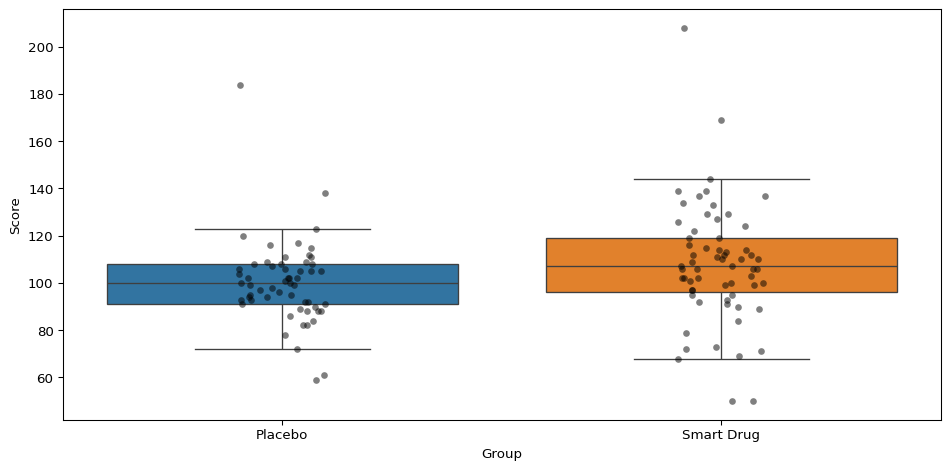
Figure 1: Distributions of IQ for the two groups.
The Illusion of Objectivity
- Goal: determine the effectiveness of vitamin C in treating the common cold (Berger and Berry. 1988)
- Hypothesis: vitamin C has no effect on the common cold (“null hypothesis”)
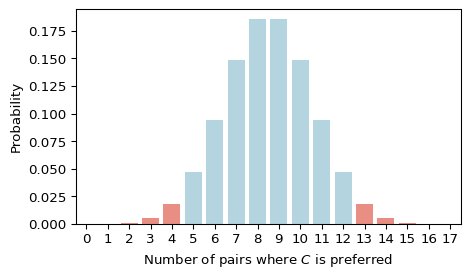
- Experiment: 17 matched pairs
- C: subject receives vitamin C
- P: subject receives placebo
- Outcome: does the subjecting receiving C or the subject receiving P exhibit greater relief after treatment?
- Results:
- 13 pairs: C is better
- 4 pairs: P is better
Explore the results space
Discussion
- Observing 13 preferences for C is somewhat unexpected when H is true
- Proof by contradiction
- Assume that H is true, and find a consequence R that logically follows from H yet is known to be false
- This contradiction shows that H cannot be true
- In standard statistics:
- H is the null hypothesis
- R is the observed or more extreme values
- Assume that H is true, and find a consequence R that logically follows from H yet is known to be false
- \(p\) = 0.049
References
Berger, James O., and Donald A. Berry. 1988. “Statistical Analysis and the Illusion of Objectivity.” American Scientist 76 (2): 159–65.
Dienes, Zoltan. 2011. “Bayesian Versus Orthodox Statistics: Which Side Are You On?” Perspectives on Psychological Science 6 (3): 274–90. https://doi.org/10.1177/1745691611406920.
The Curious Case of Thomas Bayes